EPF Scheme 2026 vs EPF 1952: Every Change Explained
On 29 June 2026, the Ministry of Labour and Employment notified three gazette schemes — G.S.R. 525(E), 526(E) and 527(E) — under the Code on Social Security, 2020. They supersede the EPF Scheme 1952, the EDLI Scheme 1976, and both the EPS 1995 and the Employees’ Family Pension Scheme 1971. The Central Board of Trustees approved them at its 239th meeting on 2 March 2026.
If you already hold an EPF account, you do not need to do anything to stay a member.
What carried over untouched
Your balance, UAN, contribution history and pensionable service move across automatically. There is no re-enrolment, no fresh application, no new account number.
Contribution stays at 12% from you and 12% from your employer, with 10% continuing for notified classes of establishments. The wage ceiling remains ₹15,000 a month. Interest for FY 2025-26 stays at 8.25%. The pension formula is unchanged: pensionable wages × pensionable service ÷ 70. Tax treatment is untouched.
Claims that your PF is “capped at ₹1,800” or that nominations were cancelled wholesale are wrong.
The ceiling is no longer written into the scheme
This is the change with the longest reach, and almost nobody has flagged it.
The 1952 Scheme fixed the wage ceiling in its own text. The 2026 Scheme does not. It refers only to a ceiling “notified by the Central Government from time to time.”
₹15,000 is now an administrative figure, not a figure embedded in the scheme. Any future revision needs one notification — not a new scheme, and not the multi-year process the ₹6,500 to ₹15,000 move required in 2014.
Contribution above ₹15,000 is now your employer’s call
If your basic exceeds ₹15,000 and your employer has been contributing on full wages, that portion is now formally classed as voluntary contribution on higher wages. Either side may reduce or stop it.
Your employer’s only binding obligation is 12% of ₹15,000. Ask HR which route your organisation is taking before your next appraisal cycle — the answer changes your take-home and your corpus.
VPF is separate and unaffected: your own top-up, never matched by the employer.
Paragraph 44: the nomination trap
Para 44 states that a fresh nomination must be made on marriage, and any nomination made before it is deemed invalid.
An honest clarification, since most coverage gets this wrong: the requirement itself is not new. The old Form 2 carried the same wording. What changed is that it now sits in the scheme text, and “family” follows the Code’s definition. The practical consequence is unchanged and widely ignored — millions still have a parent named from their first job.
You are not required to nominate your spouse. You are required to file again. That one nomination governs your EPF, EPS and EDLI payouts together.
EPFO now works to a clock
Complete claims clearing automated checks: 3 days. Pension and EDLI claims: 20 days. Deficiencies must be communicated inside the same window.
Miss it without sufficient cause and 12% annual penal interest accrues on the benefit — recoverable from the responsible Commissioner’s salary. Penal interest was previously pegged to the prevailing EPF rate; fixing it at 12% raises the cost of delay.
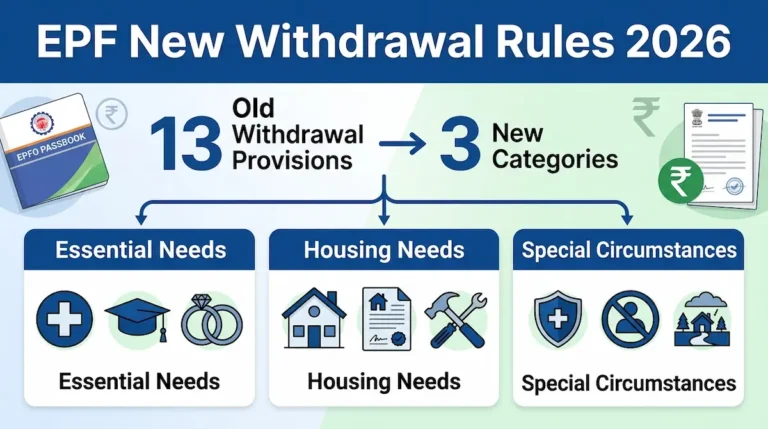
The three simplified withdrawal categories sit outside this transition and are covered in our guide to the new withdrawal rules.
Two changes for employers
A principal employer concept now applies: if a contractor defaults on a worker’s PF dues, liability passes upward. Para 9(6) addresses UK nationals under the India-UK social security arrangement, with detachment contributions computed on total wages as defined in the Code.
Do this week
Refile your e-nomination if you married after your last filing. Confirm your employer’s stance on contributions above the ceiling. Verify Aadhaar, PAN and bank KYC against your UAN. If a relative holds a dormant account, claim it — accumulations left unclaimed for 36 months after becoming payable turn inoperative and stop earning interest.
FAQ
- Do I need to re-register? No. Membership, balance and UAN continue automatically.
- Has 12% changed? No. Both shares remain 12% on the ₹15,000 ceiling, 10% for notified establishments.
- Is my old nomination valid? Yes, unless you married after filing it, or it conflicts with the 2026 scheme — in which case it is void to that extent.